
Subscribe
- முகப்பு
- கல்கி
- மங்கையர் மலர்
- தீபம்
- கோகுலம்/Gokulam
- முக்கிய பிரிவுகள்முக்கிய பிரிவுகள்
- தொகுப்புகள்தொகுப்புகள்
- PremiumPremium

Have you ever heard of the Manjanathi tree? I hadn't heard much about it until recently. When I first learned about it, I thought it was just another ordinary tree. But the more I discovered, the more interesting it became!
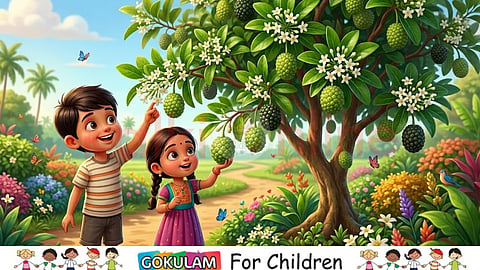
The Manjanathi tree, also known as the Indian Mulberry or Nuna tree, grows in many parts of India. It has shiny green leaves, small white flowers, and unusual fruits.
The fruit of the Manjanathi tree is not as famous as mangoes or guavas. When it is young, it is green. As it ripens, it becomes darker in color. Its bumpy appearance makes it look quite different from many other fruits.
The first time I saw a picture of it, I thought it looked like a fruit from a storybook!
One thing I found fascinating is that the tree produces small white flowers. These flowers are fragrant and grow in clusters. Even though they are tiny, they add beauty to the tree.
For many years, people have valued the Manjanathi tree for different reasons. Various parts of the tree, including its leaves, roots, and fruits, have been used in traditional practices. Because of this, the tree is considered important in many communities.
It is also called the Nuna tree.
It can grow as a small tree or a large shrub.
Its flowers are white and pleasantly scented.
The tree can grow in warm, tropical regions.
Its fruit has a unique, bumpy shape.
What I like most about the Manjanathi tree is that it is not very famous, yet it has many interesting features. It reminds me that some of nature's most amazing treasures are the ones we do not notice every day.
The next time I see an unfamiliar tree, I might stop and learn more about it. Who knows? It could be as fascinating as the Manjanathi tree!
