
Subscribe
- முகப்பு
- கல்கி
- மங்கையர் மலர்
- தீபம்
- கோகுலம்/Gokulam
- முக்கிய பிரிவுகள்முக்கிய பிரிவுகள்
- தொகுப்புகள்தொகுப்புகள்
- PremiumPremium

A Small Tool With a Big Story
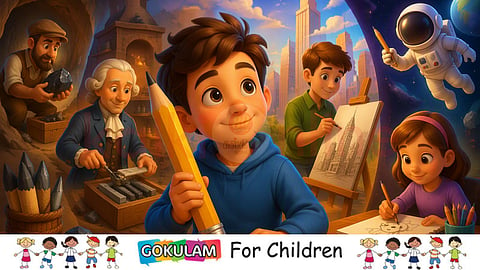
Take a look inside your school bag. What is one thing you almost always find? A pencil!
It may seem like an ordinary object, but the pencil has helped people write stories, solve maths problems, create beautiful drawings, and make amazing discoveries for hundreds of years. In fact, this simple tool has truly changed the world.
It All Started With a Black Rock
The story of the pencil began in 1564 in England, where a large deposit of a shiny black mineral called graphite was discovered.
At first, people thought it was a type of lead, so they called it “black lead.” Later, scientists discovered it was actually graphite, a form of carbon—the same element found in diamonds!
People wrapped sticks of graphite in string or sheepskin so they could hold them without getting their hands dirty
The Birth of the Modern Pencil
As graphite became popular, inventors searched for a better way to use it. In 1795, French inventor Nicolas-Jacques Conté mixed powdered graphite with clay and baked it in a kiln. This clever invention made pencil leads stronger and allowed manufacturers to create different grades—from soft, dark pencils to hard, light ones.
Soon, graphite was placed inside wooden cases, creating the pencil we know today.
More Than Just Writing
Did you know that astronauts have used pencils in space? Artists use them to create masterpieces, architects sketch buildings with them, and engineers design bridges, cars, and machines using simple pencil drawings before turning them into reality.
Even today, many famous writers and inventors prefer to begin their ideas with a pencil because mistakes can be erased easily.
A Tool That Never Goes Out of Style
Although we now have computers, tablets, and smartphones, billions of pencils are still made every year.
They don't need batteries, electricity, or an internet connection. All they need is a curious mind and a creative hand.
The next time you sharpen your pencil, remember—you are holding one of the greatest inventions in history. It may be small enough to fit in your pencil box, but it has helped write books, solve mysteries, design inventions, and shape the world we live in today!
