
Subscribe
- முகப்பு
- கல்கி
- மங்கையர் மலர்
- தீபம்
- கோகுலம்/Gokulam
- முக்கிய பிரிவுகள்முக்கிய பிரிவுகள்
- தொகுப்புகள்தொகுப்புகள்
- PremiumPremium

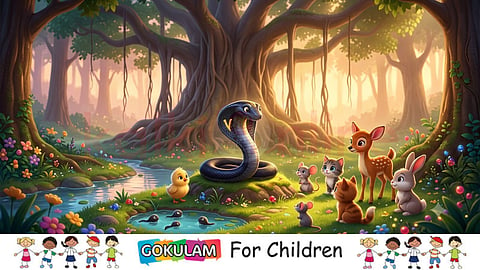
Long, long ago, to the south of the great Vindhyas, there existed an Eden-like forest. In the heart of this forest, crisscrossed by numerous jungle streams spotted with ducks and swans, there stood a huge banyan tree. It covered an area of more than a hundred metres in diameter. The tree was so old that even the youngest of its root children had four grandchildren. In the trunk of this grand old tree, there was a hole in which lived a Black cobra called Black Baba. It was a cobra of rare beauty. It looked as if it was made of black marble.
The ‘V’ mark on its hood stood out as if it was carved out of burnished gold. It had fangs, but no one remembered it having harmed any of its fellow creatures.
Actually, there was a story behind its not biting any creature since a long time ago, even under severe provocation. Years ago, there lived a sage in the vicinity of the banyan tree. He was fondly rearing a fawn which he rescued from the jaws of a tiger. One day, this fawn was frolicking in the backyard of the ashram when it accidentally trod on the tail of Black Baba, who was then a young and short-tempered fellow.
In no time, the poor fawn was bitten. The sage got furious and cursed Black Baba, “Bite one more creature and that will be your end.”
By and by, Black Baba almost forgot it had fangs. It hardly ate its natural prey for fear of biting. It turned vegetarian and lived on fruits. The severe restriction on food made it good and saintly. Every day around dusk, it would slither out of its hole and make for the small mound nearby to tell stories filled with morals. There were tadpole toddlers, blinking, stupid, aged frogs, young mischievous mice, chicks, and kittens among its audience.
Flicking its forked, glib tongue, Black Baba would go on telling story after story until it was past midnight.
One afternoon, when most of the creatures were having a nice siesta, there was a terrible roar. A monster with horns like the tusks of an elephant emerged into the canopy of the banyan tree, holding in its grip a squirming rabbit screaming for help. No creature dared to challenge the monster, not even the so-called He-elephant. A week later, around noon, when the monster was fast asleep after having its fill of half a dozen rabbits, dozens of fowls, and a full-grown deer, an emergency meeting was called under the banyan tree.
Every creature expressed its dependence on Black Baba’s wisdom.
When Black Baba saw the sad face of a mother rabbit, whose only twenty-four children the demon had made a meal of, it made up its mind. “Tonight I am going to meet this devil face to face. Now you may all go home and stay secure behind bolted doors,” it said.
The next morning, one by one, the friends of Black Baba left their homes wondering what might have happened to their Black Baba; for, in the dead of the previous night, they had heard a scream of pain and hate. It had, no doubt, been issued from the mouth of the demon.
When at last, inching their way, they reached the cave where the demon had taken up residence, a startling sight awaited them. The demon lay dead with its long, ribbon-like tongue hanging out of its froth-covered mouth. Not far from the fallen demon lay our Black Baba, dead and stiff. Everyone at once understood the sacrifice their beloved Black Baba had made. It had invoked the curse of the sage to save them.
“Baba bit the demon and died for us,” they said in unison in a choking voice.
By reading this story, you will understand the nobility of serving others at any cost and learn how selfless actions transform lives, ultimately helping you sharpen your own leadership qualities and character.
