
Subscribe
- முகப்பு
- கல்கி
- மங்கையர் மலர்
- தீபம்
- கோகுலம்/Gokulam
- முக்கிய பிரிவுகள்முக்கிய பிரிவுகள்
- தொகுப்புகள்தொகுப்புகள்
- PremiumPremium

Learn how the microscopic tardigrade, or water bear, survives in outer space, extreme heat, and radiation without a spacesuit.
Meet the World's Toughest Tiny Hero!
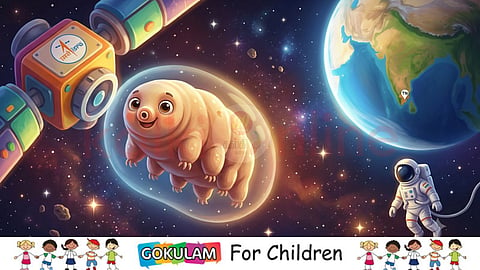
What if I told you that a tiny creature, smaller than a grain of sand, can survive in outer space without wearing a spacesuit? It sounds like a superhero, but it's real! Meet the tardigrade, also called the 'water bear'.
Small, but Super Strong
A tardigrade is only about 0.5 millimeters long, so we can't see it without a microscope. It lives in moss, soil, and even tiny drops of water. Although it looks cute with its eight little legs, it is one of the toughest animals on Earth.
A Real Space Traveler
In 2007, scientists sent tardigrades into space with the European Space Agency (ESA). They were exposed to the vacuum of space and harmful sunlight. Amazingly, many survived! When they returned to Earth and were given water, they became active again. Some even had babies!
What Is It's Secret?
When conditions become too hot, cold, or dry, the tardigrade curls into a tiny ball called a 'tun'. In this state, it almost stops all its life processes and waits until conditions improve. This amazing ability helps it survive extreme environments.
Nature's Greatest Survivor
Tardigrades can survive freezing temperatures, intense heat, powerful radiation, and even the vacuum of space. Scientists study them to learn how living things survive in extreme conditions. One day, their secrets might even help astronauts on long space missions.
The next time you see a patch of moss, remember—one of the world's toughest creatures might be hiding there.
It proves that you don't have to be big to be truly extraordinary!
Unlocking the survival secrets of the water bear equips you with a profound understanding of nature's most resilient organisms, empowering you to appreciate the microscopic wonders that push the boundaries of biology and space exploration.
