
Subscribe
- முகப்பு
- மென்பேனா
- கல்கி
- மங்கையர் மலர்
- தீபம்
- கோகுலம்/Gokulam
- முக்கிய பிரிவுகள்முக்கிய பிரிவுகள்
- தொகுப்புகள்தொகுப்புகள்
- PremiumPremium

Every generation has its demons. Some carry weapons, some wear crowns, and some hide behind screens. Their appearances change, but their nature remains the same.
Centuries ago, Narakasura ruled a kingdom. He was powerful, wealthy, and feared. Yet, he was never satisfied. He wanted more land, more wealth, and more authority. He believed that power gave him the right to control others. He punished everyone who questioned him and silenced those who disagreed with him.
Slowly, his kingdom became a place where people obeyed, but nobody was free.
Narakasura did not become a demon in a single day. His downfall began with one thought: I am more important than everyone else.
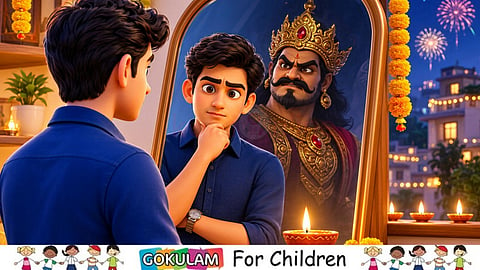
Centuries passed. Kingdoms disappeared, swords were replaced by machines, and the world entered an age of technology. But Narakasura did not disappear. He simply changed his appearance.
In a modern city lived a young man named Naren. He was intelligent, ambitious, and successful. He had a respectable job, a comfortable home, and hundreds of followers on social media.
However, Naren had a habit. He wanted to be right all the time. He dismissed opinions that challenged him, insulted people who disagreed with him, and measured his worth through the admiration of others.
He called it confidence. Others called it arrogance.
One evening, while shopping for Diwali, Naren noticed an old man arranging clay lamps outside his shop.
"Why do people still buy these?" Naren asked. "We have electric lights and modern decorations. Isn't this tradition outdated?"
The old man smiled and handed him a lamp.
"Tell me something. If you light a thousand lamps outside your house, does that guarantee that there is no darkness within it?"
Naren had no answer.
The old man continued, "We celebrate the defeat of Narakasura every year. But have you ever wondered whether he still exists?"
Naren laughed. "How can a demon from mythology exist today?"
"Perhaps he no longer needs a kingdom. Perhaps he lives in every mind that is controlled by greed, pride, jealousy, and hatred.
Perhaps he appears whenever we believe our desires are more important than another person's happiness."
Naren walked away, but the words followed him.
That night, he thought about his behaviour towards his colleagues, friends, and family. He remembered the people he had insulted, the apologies he had refused to offer, and the opinions he had never cared to hear.
For the first time, he wondered whether he had been fighting demons outside while protecting one within himself.
The next morning, he apologised to a colleague he had repeatedly humiliated.
It was not an easy victory, but it was a beginning.
That Diwali, Naren lit a small clay lamp near his window.
He finally understood that Narakasura's defeat was not merely a story of a demon killed centuries ago. It was a reminder of a battle that continues within every human being.
After all, the most dangerous demon is not the one we fear, but the one we fail to recognise within ourselves.