
Subscribe
- முகப்பு
- மென்பேனா
- கல்கி
- மங்கையர் மலர்
- தீபம்
- கோகுலம்/Gokulam
- முக்கிய பிரிவுகள்முக்கிய பிரிவுகள்
- தொகுப்புகள்தொகுப்புகள்
- PremiumPremium

The Platypus: Nature’s Most Unbelievable Puzzle
A duck’s bill, an otter’s feet, and a beaver’s tail?
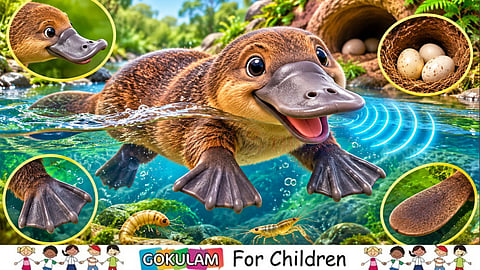
Imagine an animal with a duck-like bill, webbed feet, a furry body, and a flat tail. Now imagine it lays eggs but feeds its babies milk! Sounds like someone mixed several animals together, doesn't it?
Meet the platypus, one of the strangest mammals on Earth. It lives in freshwater rivers and streams in eastern Australia and Tasmania. With its unusual appearance and remarkable abilities, this animal seems almost too strange to be real!
An Egg-Laying Mammal
Most mammals give birth to live babies, but the platypus belongs to a rare group called monotremes, which lay eggs.
The only other living monotremes are echidnas, sometimes called spiny anteaters. A female platypus lays her eggs inside a burrow near the water. When the babies hatch, their mother feeds them milk. But here's another surprise: she has no nipples! Instead, milk seeps through special openings in her skin and collects in her fur, where her babies lick it up.
Nature certainly doesn't follow just one recipe!
Hunting Without Seeing
The platypus hunts underwater for small creatures such as insect larvae, worms, and freshwater crustaceans.
When diving, it closes its eyes, ears, and nostrils. So how does it find food in dark, muddy water?
Its sensitive bill detects tiny electrical signals produced by the muscles of nearby prey. This ability, called electroreception, helps the platypus locate food without relying on sight.
Imagine finding your dinner without even opening your eyes!
A Venomous Surprise
The platypus has another unusual secret. Males possess sharp spurs on their hind legs connected to venom-producing glands. They can deliver venom through these spurs, particularly during the breeding season.
Although a platypus is unlikely to attack people, its venom can cause intense pain and swelling. That cute, furry animal is definitely not something to cuddle in the wild!
Designed for Water
The platypus's front feet help it paddle, while its back feet assist with steering.
Its broad tail stores fat, providing an energy reserve when food is scarce. Thick, waterproof fur helps keep its body warm in cool water.
Every strange feature has a useful purpose!
Scientists Thought It Was Fake!
When a platypus specimen reached British scientists in the late 1700s, some suspected someone had sewn parts of different animals together. Its combination of features seemed unbelievable.
Today, scientists recognize the platypus as a real animal and an extraordinary example of mammal evolution.
The platypus proves that nature doesn't need imagination borrowed from fairy tales—it creates its own surprises!