
Subscribe
- முகப்பு
- கல்கி
- மங்கையர் மலர்
- தீபம்
- கோகுலம்/Gokulam
- முக்கிய பிரிவுகள்முக்கிய பிரிவுகள்
- தொகுப்புகள்தொகுப்புகள்
- PremiumPremium

Who Invented the Emoji?
From Tiny Pictures to a Worldwide Language
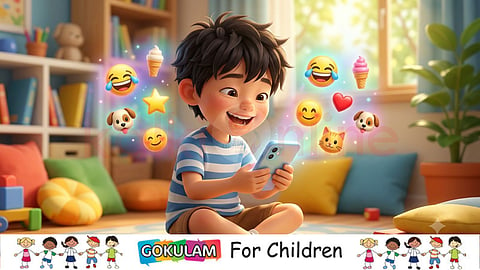
😊 ❤️ 😂 — We see emojis everywhere! We use them in messages, comments, games, and even school group chats. But have you ever wondered who created these tiny pictures?
The story begins in Japan in the 1990s.
Meet Shigetaka Kurita
In 1999, a Japanese designer named Shigetaka Kurita created a set of 176 tiny images for a mobile internet service called i-mode, developed by the Japanese company NTT DoCoMo.
Kurita wasn't trying to create funny decorations. He wanted to help people communicate emotions and information using very little space on tiny mobile phone screens.
His original emojis included simple pictures such as weather symbols, hearts, food, animals, and faces.
Emoji or Emoticon?
Here's something that can be confusing: emojis aren't the same as emoticons.
Emoticons are made using ordinary keyboard characters, such as :-) or :(.
An emoji is an actual picture or symbol.
The word emoji comes from Japanese: "e" means picture, and "moji" means character.
How Did Emojis Take Over the World?
For years, emojis were especially popular in Japan. Then smartphones and social media helped them spread worldwide.
In 2010, emojis were added to the Unicode Standard, allowing different computers and phones to represent the same emoji consistently.
Today, there are thousands of emojis, representing food, animals, objects, activities, people, flags, and emotions.
More Than Just Cute Pictures
Emojis have become a new way of communicating. A single ❤️ can show affection, while 😂 can completely change the feeling of a sentence.
They can even help people communicate when they don't speak the same language.
A Tiny Revolution
What started as a collection of 176 tiny pictures became a global communication system.
So, the next time you send 😂 or ❤️, remember: you're using an idea that began with a Japanese designer trying to make communication easier on a tiny phone screen.
