
Subscribe
- முகப்பு
- கல்கி
- மங்கையர் மலர்
- தீபம்
- கோகுலம்/Gokulam
- முக்கிய பிரிவுகள்முக்கிய பிரிவுகள்
- தொகுப்புகள்தொகுப்புகள்
- PremiumPremium

Nowadays festivals are not celebrated as they were celebrated sixty years ago. The one important thing that made festivals like Diwali and Navratri vibrant and ebullient those days was the participation and role played by children. Those days, festivals were observed more for making children happy than for any other reason. When I was a boy, we children used to look forward to Diwali, Navratri, and Janmashtami with impatience and great expectations in our hearts.
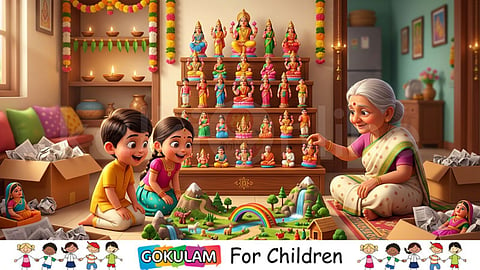
While Diwali and Janmashtami were single-day, fleeting events, Navaratri is a nine-day-long celebration. The day before the commencement of the Navaratri festival, the big wooden Navaratri trunk used to be gingerly lowered from the attic, dusted, and opened.
Stacked delicately inside were dolls, a number of them rolled up in back numbers of newspapers. We used to greet each one of the dolls with glee as it emerged from its yearlong hibernation. Many of these dolls had seen many a Navaratri. Stair-like steps would be built against a wall of the living room.
My grandmother was the person who decided the order in which dolls were to be displayed, rungwise. She allowed only dolls of gods and goddesses on the display stairs. After dolls occupied their respective places, work on the creation of a landscape on the floor would start.
Visiting children loved this section. A hill would be there with waterfalls. In some households, you could find an entire zoo.
Display of dolls was only one side of the coin. The other side was the preparation of the special delicacy called sundal, with which the visitors, especially children, were served. We children visited every house in our neighborhood, uninvited, daily in the evenings, not only to feast on the display of dolls, but also to taste this delicacy called Kolu sundal.
I remember a house in our locality where we were asked to rate the doll display and the dhal sundal. The aunty of this house kept a visitor's book in which separate sections were provided for the rating of Kolu and sundal. The credit for a good rating for the display went to the uncle, and the credit for a good rating for the sundal went to the aunty.
Present-day children are losing interest in celebrating festivals because adulthood is being thrust upon them very early in their life. Even toddlers are told to stand on their own shaky legs. When there is no childhood, where is the question of a festive mood?
